Sign in to like and rate
Whether you're a seasoned boater or new to the water, there are many specialized terms and phrases used in the boating world that can be confusing. To help you navigate this terminology, we've put together a comprehensive glossary of boating terms. From common terms like "anchor" and "buoy" to more specialized terms like "bow thruster" and "tiller," this glossary covers it all. So whether you're looking to brush up on your boating vocabulary or simply want to learn something new, this guide is the perfect resource.
Anchoring | Boating Equipment | Electrical Systems | General Boating Terms |Â Marine Lighting | Parts of a Boat | Stabilizers | Thrusters | Wipers
AnchoringÂ
Anchor Rode | The line that secures the boat to the anchor. It may consist of all chain, all rope, or rope spliced to chain |
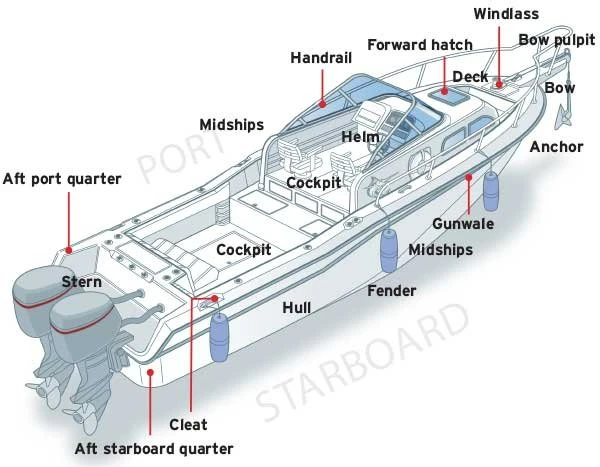
Anchor Windlass | A powered or manual winch designed specifically for hauling or deploying a boat's anchor. Typically mounted in the bow. |
Anchoring Scope | The amount of anchor rode let out when anchoring, relative to the depth of the water. Conventional wisdom is that scope should be six times the depth of the water you're anchoring in. |
Bow Roller | A wheel mounted on the bow or sprit of a boat which the anchor rests on when it is up, and which helps the anchor rode smoothly roll over the edge of the boat when being deployed or hauled. |
Capstan | Often referred to as a drum or rope drum, the capstan is used primarily for hauling rope. Can stand alone or be a part of an anchor windlass when paired with a chainwheel. |
Chainstopper | Located between the anchor windlass and the bow roller to secure the chain and anchor so as to take the load of the anchor off of the windlass. |
Chainwheel | Part of an anchor windlass. A special wheel with pockets to accommodate a specified chain size for hauling up the chain and anchor. Some chainwheels are designed to handle both chain and rope, which others handle only chain. Also referred to as a gypsy or wildcat |
Electric Windlass | An anchor windlass that is powered with an electric motor |
Horizontal Windlass | An anchor windlass with the main drive shaft oriented horizontally |
Hydraulic Windlass | An anchor windlass that is powered with a hydraulic motor |
Manual Windlass | An anchor windlass powered by hand with a handle |
Topworks | The part of a vertical anchor windlass that is above deck. |
Vertical Windlass | An anchor windlass with the main drive shaft oriented vertically |
Windlass Chain | Chain that is manufactured specifically to run through an anchor windlass. It is manufactured so that each link of the chain is exactly the same size as all others certified by the ISO |
Boating Equipment
Anode | A sacrificial metal, often zinc, that is meant to erode via electrolysis before more important metals installed on the boat below the water line like propellers and propeller shafts. |
Bilge Pump | A pump located in the bilge of a boat or ship designed to pump any excess water that collects there overboard. Typically activated automatically with a float switch as an integral piece of safety equipment. |
Ground Tackle | A collective term for the anchor rode and anchor combined. |
Holding Tank | A tank on the boat that contains all waste water. |
Interceptors | Small vertical blades mounted to the transom of a boat perpendicular to the surface of the water that deploy to generate lift on the back of the boat which can both stabilize the riding angle of the boat and help it get on plane faster. See Zipwake interceptors. |
Table Pedestal | A column that mounts to the deck and to a table to support the weight of a table. |
Trim Tabs | Small surfaces mounted to the transom of a boat parallel to the surface of the water , used to change the angle of the boat as it runs through the water by angling the tab up or down with an actuator. |
Electrical Systems
Cable Run | The complete length of electrical cable that connects a power source to a power consumer and back. For example, if a battery is 20-feet away from an electric motor it is powering, the cable run is 40=feet. |
Float Switch | A switch that has buoyancy that activates when it begins to float in water, and deactivates when it is no longer floating. |
Wire Gauge | The measure of a diameter of a wire; any of a series of standard sizes in which wire is made |
General Boating Terms
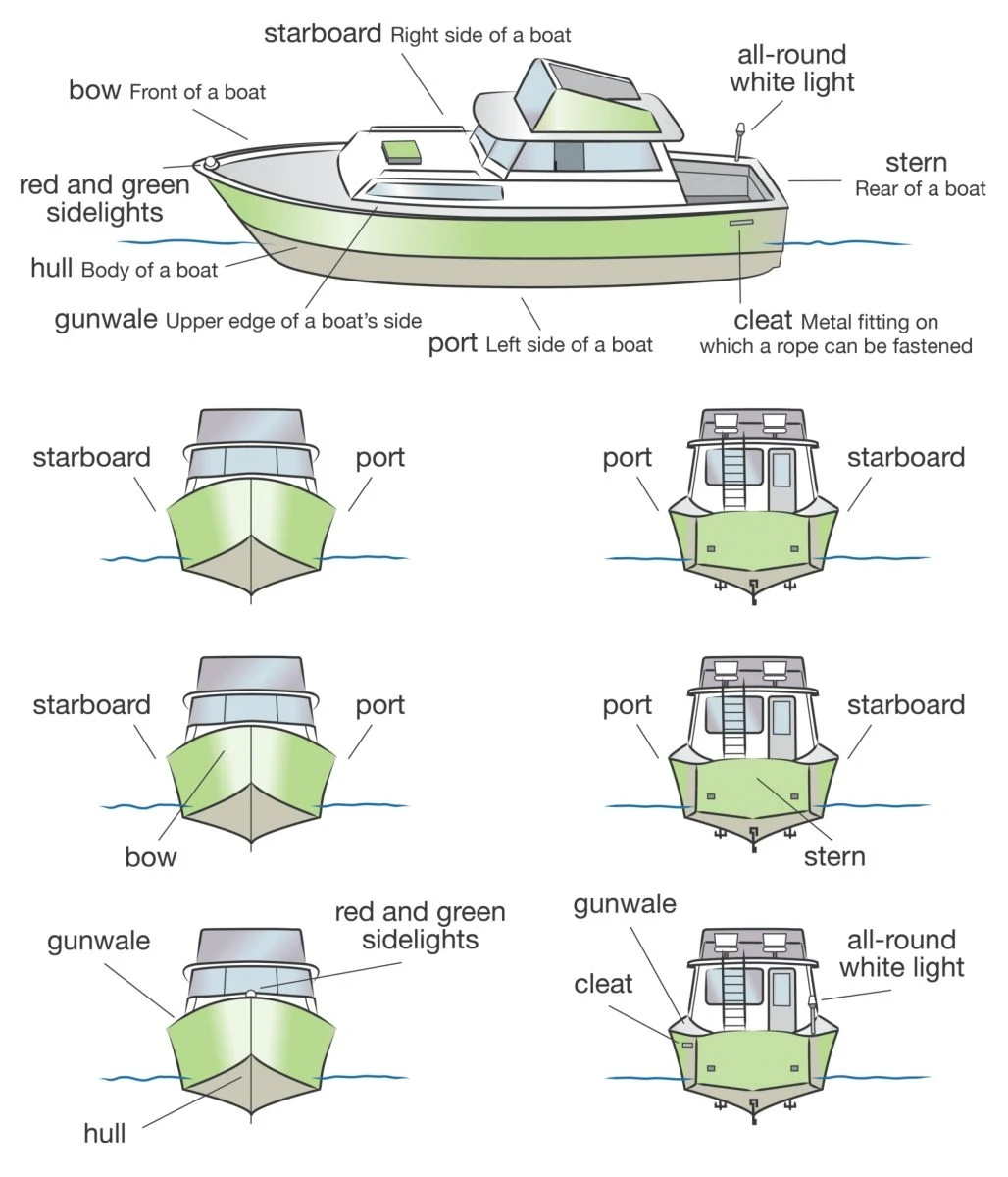
Aft | At, near, or towards the stern of a boat. |
Beam | The width of a boat at its widest point. |
Capsize | When the boat turns on its side or upside down |
Catamaran | A two-hulled boat, with the hulls side by side. |
Displacement | The weight of water displaced by a floating vessel. The way to measure the weight of a boat in water. |
Draft | The vertical distance from the lowest point of a boat to the surface of the water |
Dry Weight | The weight of a boat out of the water |
Freeboard | The vertical distance from the surface of the water to the gunwhale of the boat. |
Heading | Intended direction of travel of a boat; where the bow is pointed. |
Planing | The process of gliding easily through the water at high speeds with optimal running surface. |
Running Surface | All parts of the boat that are in contact with the water while the boat is moving. |
Wake | The waves created trailing a boat as it moves through the water |

Marine Lighting
Color Temperature | A way to describe the appearance of light emitted from a fixture or bulb. It is measured in degrees Kelvin (K) on a scale of 1,000 - 10,000 |
LED | Light-Emitting Diode. |
Candela | A unit of measure for light intensity referring to the amount of light emitted by a lighting device in a particular direction |
Lumen | A unit of measure for perceived light intensity referring to the total amount of light a light source emits |
Navigation Lights | a set of lights, typically colored, shown by a boat or ship at night or in low-visibility weather to indicate its position and orientation, especially with respect to other vessels. |
Running Lights | Lights required to be shown on boats underway at night. |
Parts of a Boat
Aft Deck | The deck of a boat towards the stern. |
Bilge | The lowest compartment of boat or ship. |
Bow | The front of a boat. |
Bow Sprit | a spar extending forward from a boat's bow |
Bridge | An elevated location from which a large vessel, ship or yacht is steered and its speed controlled. |
Bulkhead | A vertical partition separating compartments. |
Chine | The intersection of the bottom and sides of the boat |
Foredeck | The deck of a boat towards the bow. |
Forepeak | The forward most internal compartment of a boat. |
Galley | The kitchen area of a boat |
Gunwhale | The upper edge of the side of a boat. |
Head | The restroom area of a boat, ship, or yacht |
Helm | The location from which you drive the boat, where the steering wheel, tiller, throttle and any associated equipment for steering are located. |
Hull | The main body of a vessel |
Keel | The centerline of a boat running for and aft; the backbone of a vessel. |
Port Side | Left side of a boat |
Rudder | A vertical plate or board attached to the bottom of a boat on a shaft used for steering a boat by directing water port or starboard as it is turned through the water. |
Salon | Cabin area of a boat devoted to seating, often combined with a dining table. |
Settee | A long seat with a back to accommodate several persons at once, typically built-in to the structure of the interior of the boat |
Starboard Side | Right side of a boat |
Stern | The back of a boat. |
Topsides | The sides of a vessel between the waterline and the deck |
Transom | Flat surface forming the stern of the boat, typically perpendicular to the surface of the water. |

Stabilizers
Boat Stabilizers | A system consisting either of a set of fins under the hull or a gyro inside the boat for the purpose of keeping the boat from rocking back and forth in swells. |
Gyro Stabilizer | A stabilization system for boats that is mounted internally to the boat and uses a weighted flywheel to produce centrifugal force preventing the boat from rolling side to side in ocean swells. |
Stabilizer Fin | A fin, or wing, attached to the bottom of the hull of a boat which pivots on a shaft to provide a stabilizing force preventing the boat from rolling side to side in ocean swells. |
Thrusters
Bow Thruster | A device mounted in the bow of a boat designed to push the bow of the boat left or right, typically with a propeller that pushes and pulls water perpendicular to the direction the boat is pointing |
Gearleg | The lower unit of a bow or stern thruster with internal gears to drive the propeller shaft. The propeller(s) and anode(s) are attached to the gearleg. |
Stern Thruster | A device mounted in the stern of a boat designed to push the bow of the boat left or right, typically with a propeller that pushes and pulls water perpendicular to the direction the boat is pointing |
Wipers
Pantograph Wiper | A pantograph wiper system involves two metal arms to connect one wiper motor to one wiper blade. In some cases, the arm is connected to two separate drive shafts coming out of the motor, and in others, one of the pantographic arms is on a stationary pivot while the other is connected to a single drive shaft. Pendulum wiper systems can clear more area of glass than pendulum wipers. |
Pendulum Wiper | A single metal arm to connect the wiper motor to the wiper blade, sweeping the glass in a pie-shaped pendulum motion. Pendulum wipers are most commonly found on car wiper systems. |
Wiper Arm | A metal arm connecting the drive shaft of a wiper motor to the wiper blade |
Wiper Motor | Electric motor used to drive windshield wiper arms & blades |
Now that you're familiar with all the important boating terms, it's time to put your knowledge to the test on the water! Whether you're a seasoned sailor or a first-time boater, Imtra has everything you need to make your next voyage a success. From lighting and wipers to thrusters and stabilizers, our top-of-the-line trim control and interceptor systems will ensure that your boat is safe, efficient, and comfortable. Visit our website or contact us today to learn more and start your next adventure!
Please sign in to post a comment.